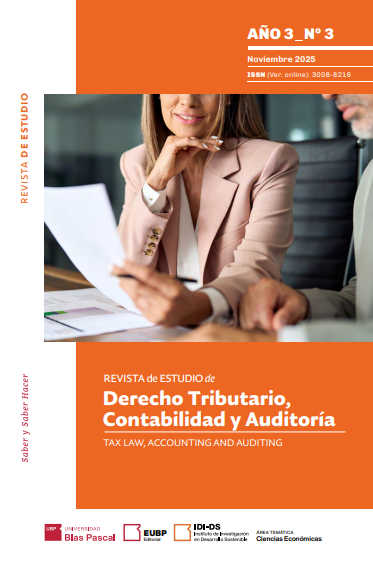
Artificial intelligence applied to external auditing
a systematic literature
DOI:
https://doi.org/10.37767/3008-8216(2025)001Keywords:
Artificial intelligence, External auditing, Systematic review, Technology adoptionAbstract
This article presents a systematic review of the scientific literature on the application of artificial intelligence (AI) in external auditing, covering studies published between 2010 and 2025 in Q1 journals of auditing, financial accounting and technology. From a search of Science Direct, Google Scholar, JSTOR, and EBSCO, 19 empirical and conceptual articles were identified that meet high-impact criteria (more than 10 citations). The lines of argument, the theoretical and methodological frameworks used, as well as debates on adoption gaps between large and small firms, ethical challenges and regulatory gaps are examined. Finally, opportunities for future research in areas such as technology interoperability, training, and systems governance are pointed out, in order to guide auditors in the effective integration of AI into external audit practice.
Downloads
References
AFSAY, Akram; TAHRIRI, Arash; REZAEE, Zabihollah (2023). “A meta-analysis of factors
affecting acceptance of information technology in auditing”. International Journal of Accounting Information Systems, vol. 49, p. 100608. https://www.sciencedirect.com/science/article/abs/pii/S1467089522000604?via%3Dihub
AL-GNBRI, Mohamed Kais (2022). “Accounting and auditing in the metaverse world from a virtual reality perspective: A future research”. Journal of Metaverse, vol. 2, no 1, p. 29-41. https://dergipark.org.tr/en/download/article-file/2404096
ALLES, Michael; GRAY, Glen (2024). “The marketing on Big 4 websites of Big Data Analytics in the external audit: Evidence and consequences”. International Journal of Accounting Information Systems, vol. 54, p. 100697. https://www.sciencedirect.com/science/article/abs/pii/S1467089524000307?via%3Dihub
CHAN, David Y.; VASARHELYI, Miklos A. (2018). “Innovation and practice of continuous Auditing1”. En Continuous Auditing. Emerald Publishing Limited, p. 271-283. https://doi.org/10.1108/978-1-78743-413-420181013
EARLEY, Christine E. (2015). “Data analytics in auditing: Opportunities and challenges”. Business horizons, vol. 58, no 5, p. 493-500. https://doi.org/10.1016/j.bushor.2015.05.002
ELNAHASS, Marwa; JIA, Xinrui; CRAWFORD, Louise (2024). “Disruptive technology and audit risks: Evidence from FTSE 100 companies”. Emerging Markets Review, vol. 63, p. 101218. https://doi.org/10.1016/j.ememar.2024.101218
GOTO, Masashi (2023). “Anticipatory innovation of professional services: The case of
auditing and artificial intelligence”. Research Policy, vol. 52, no 8, p. 104828.
GU, Hanchi; SCHREYER, Marco; MOFFITT, Kevin; VASARHELYI, Miklos (2024). “Artificial
intelligence co-piloted auditing”. International Journal of Accounting Information Systems, vol. 54, p. 100698. https://doi.org/10.1016/j.accinf.2024.100698.
HUANG, Feiqi; VASARHELYI, Miklos A. (2019) “Applying robotic process automation (RPA) in auditing: A framework”. International journal of accounting information systems, vol. 35, p. 100433. https://doi.org/10.1016/j.accinf.2019.100433
KRIEGER, Felix; DREWS, Paul; VELTE, Patrick (2021). “Explaining the (non-) adoption of
advanced data analytics in auditing: A process theory”. International journal of accounting information systems, vol. 41, p. 100511. https://doi.org/10.1016/j.accinf.2021.100511
LAUX, Johann; WACHTER, Sandra; MITTELSTADT, Brent (2021). “Taming the few: Plat
form regulation, independent audits, and the risks of capture created by the DMA
and DSA”. Computer law & Security review, vol. 43, p. 105613. https://doi.org/10.1016/j.clsr.2021.105613
LENG, Aolin; ZHANG, Yue (2024). “The effect of enterprise digital transformation on audit efficiency—Evidence from China”. Technological forecasting and social change, vol. 201, p. 123215. https://doi.org/10.1016/j.techfore.2024.123215
LUAN, Fushu; ZHANG, Zhonghui; CHEN, Yang (2025). “Audit quality and digitalisation in shaping firm innovation strategy: Evidence from China”. Technology in Society, vol. 81, p. 102807. https://doi.org/10.1016/j.techsoc.2024.102807
MANITA, Riadh; ELOMMAL, Najoua; BAUDIER, Patricia; HIKKEROVA, Lubica (2020). “The digital transformation of external audit and its impact on corporate governance”. Technological Forecasting and Social Change, vol. 150, p. 119751.
https://doi.org/10.1016/j.techfore.2019.119751
PERDANA, Arif; LEE, W. Eric; KIM, Chu Mui (2023). “Prototyping and implementing Robotic Process Automation in accounting firms: Benefits, challenges and opportunities to audit automation”. International Journal of Accounting Information Systems, vol. 51, p. 100641. https://doi.org/10.1016/j.accinf.2023.100641.
SACHAN, Swati; LIU, Xi (Lisa) (2024). “Blockchain-based auditing of legal decisions supported by explainable AI and generative AI tools”. Engineering Applications of Artificial Intelligence, vol. 129, p. 107666. https://doi.org/10.1016/j.engappai.2023.107666.
VITALI, Sonia; GIULIANI, Marco (2024). “Emerging digital technologies and auditing firms: Opportunities and challenges”. International Journal of Accounting Information Systems, vol. 53, p. 100676. https://doi.org/10.1016/j.accinf.2024.100676.
WERNER, Michael; WIESE, Michael; MAAS, Annalouise (2021). “Embedding process mining into financial statement audits”. International Journal of Accounting Information Systems, vol. 41, p. 100514. https://doi.org/10.1016/j.accinf.2021.100514.
ZHANG, Lu; SULONG BIN BALIA, Sophee (2024). “Digital transformation and corporate audit risk: Mediating effects of auditor behavior”. Finance Research Letters, vol. 67, parte A, p. 105754. https://doi.org/10.1016/j.frl.2024.105754
 English
 Spanish